Introduction to Solar Eclipses
Solar eclipses are astronomical events that occur when the Moon passes between the Earth and the Sun, momentarily blocking the Sun’s light. These celestial phenomena have held great significance throughout history, not only in scientific terms but also culturally and spiritually. The upcoming solar eclipse, set to occur on April 8, 2024, is expected to draw attention from millions of viewers across North America, marking an important event in both the scientific community and popular culture.
The Mechanics of Solar Eclipses
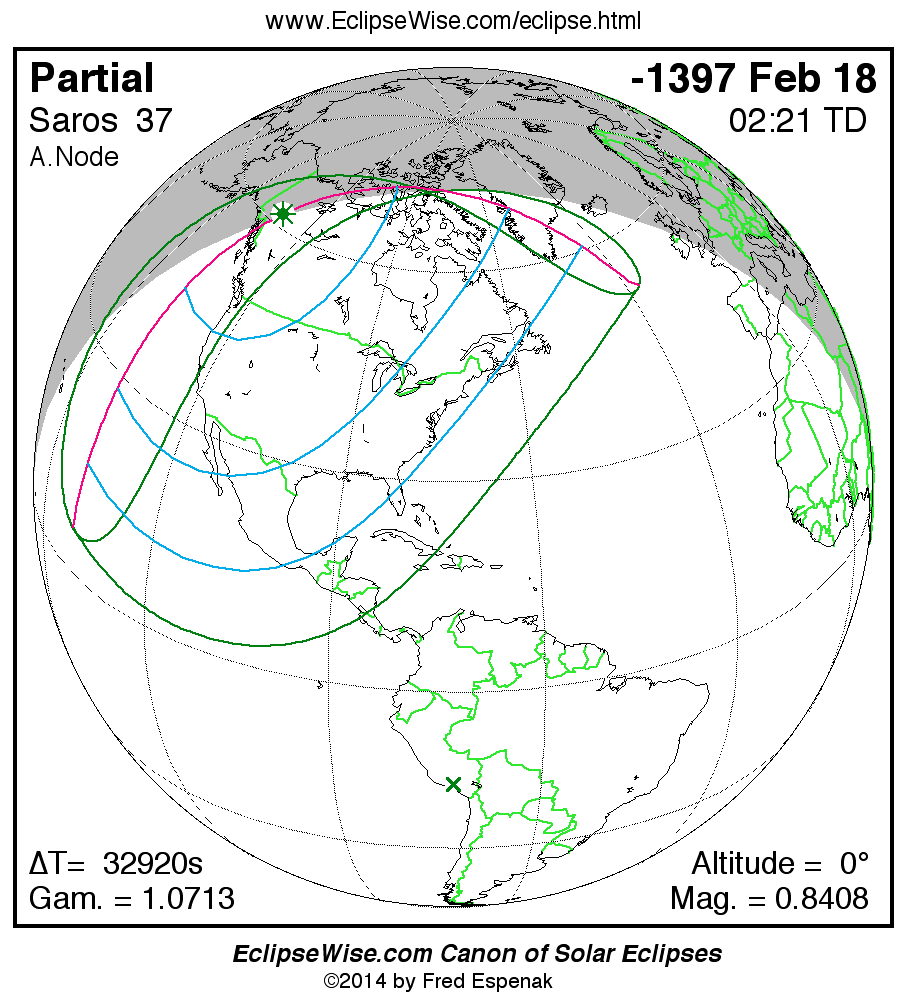
There are three primary types of solar eclipses: total, partial, and annular. In a total solar eclipse, the Moon completely covers the Sun, allowing viewers within the path of totality to witness a dramatic darkening of the sky and possibly even the solar corona. A partial solar eclipse occurs when only a portion of the Sun is obscured, while an annular eclipse features a ring-like appearance of the Sun, as the Moon does not cover the entire disk due to its distance from Earth.
Significant Historical and Cultural Impact
Historically, solar eclipses have been seen as omens or significant events in various cultures. Ancient civilizations like the Babylonians and the Aztecs meticulously recorded these occurrences, often attributing meaning to them that influenced political and social decisions. In modern times, solar eclipses continue to be key moments for scientific research. They provide unique opportunities for astronomers to study the Sun’s atmosphere and conduct experiments that can only be performed during these brief intervals.
Upcoming Solar Eclipse in April 2024
The next total solar eclipse will take place in just a few months, on April 8, 2024, and will cross a wide swath of North America, from Mexico through the United States and into Canada. Cities such as Dallas, Indianapolis, and Montreal are within the path of totality, making this a rare opportunity for millions to experience the wonder of a total solar eclipse. NASA has already begun preparing observations and public engagement activities, ensuring that the event is accessible and educational for all.
Conclusion
Solar eclipses are not just remarkable astronomical events; they also serve as opportunities to unite us in wonder and curiosity. As we look forward to the total solar eclipse in April 2024, it’s a chance not only for scientific exploration but also for cultural celebrations and shared experiences. Whether a seasoned astronomer or a first-time viewer, the significance of solar eclipses lies in their ability to captivate and inspire. As we await this celestial spectacle, the anticipation and excitement surrounding solar eclipses will continue to grow.