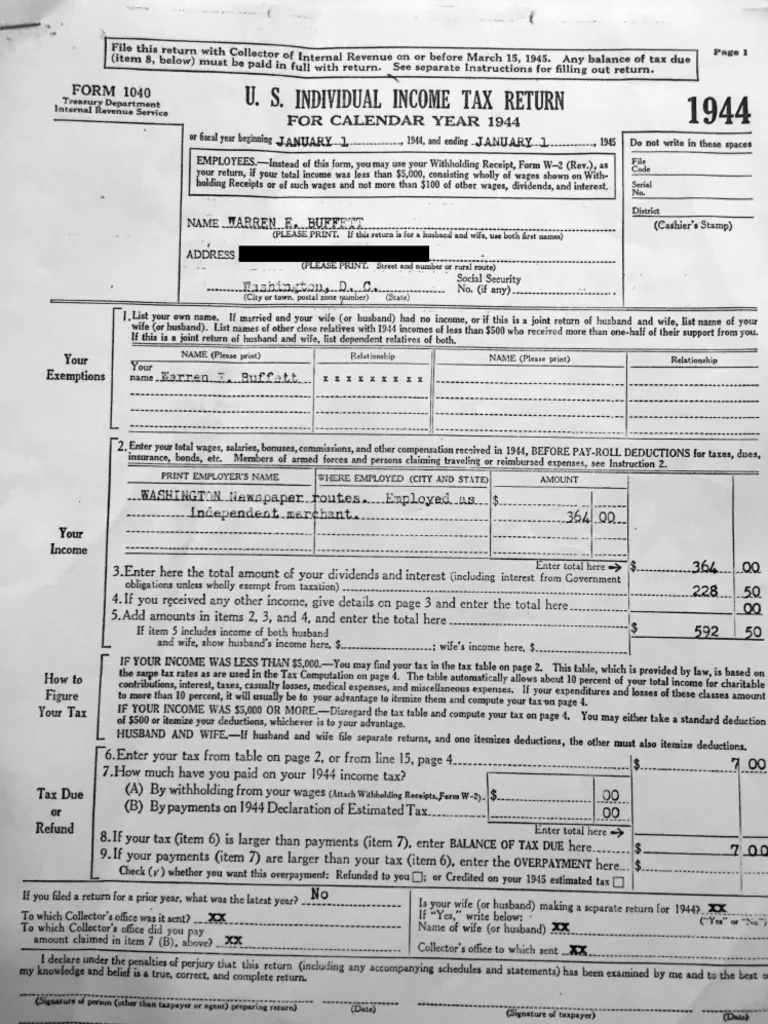
What does Warren Buffett’s first tax return reveal about the financial beginnings of one of the world’s most successful investors? Filed on April 14, 1944, when Buffett was just 14 years old, this document not only marks a significant milestone in his life but also provides a fascinating glimpse into his early entrepreneurial ventures.
In that year, Buffett earned a total of $592.50, a sum that would equate to approximately $11,244.32 in today’s currency. His income was derived from two primary sources: $364 from his paper route and $228.50 from interest and dividends on his investments. Under the IRS rules of the time, any U.S. citizen earning $500 or more was required to file a federal tax return, which Buffett dutifully did, despite his modest earnings.
Buffett’s tax obligation for the year was a mere $7, which, when adjusted for inflation, would be valued at around $132.84 today. This early experience with taxes is notable not only for its simplicity but also for the insights it provides into Buffett’s lifelong relationship with money and investing. He famously remarked, “I have paid federal income tax every year since 1944. Though, being a slow starter, I owed only $7 in tax that year.”
Interestingly, Buffett also took advantage of deductions available at the time, claiming $10 for watch repair and $35 for bicycle costs. These deductions, while small, illustrate his early understanding of financial management and tax benefits. His father, Howard Buffett, a stockbroker and U.S. Congressman, likely influenced his early financial literacy and investment strategies.
Fast forward to 2024, and Buffett’s company, Berkshire Hathaway, made headlines by paying $26.8 billion in taxes, the highest-ever payment made to the U.S. government by a single company. This stark contrast between his early tax obligations and the current tax contributions of his company underscores the vast financial journey Buffett has undertaken since those formative years.
Buffett’s early ventures into entrepreneurship began at the age of 11, laying the groundwork for his future as a legendary investor. His first tax return is not just a document; it symbolizes the start of a remarkable career that would see him become one of the wealthiest individuals in the world.
As we reflect on Buffett’s first tax return, it serves as a reminder of how far he has come and the principles of investing and financial responsibility that he has adhered to throughout his life. While much has changed since 1944, Buffett’s commitment to paying taxes remains steadfast, as he continues to advocate for a fair tax system, stating, “Debbie works just as hard as I do, and she pays twice the rate I pay. I think that’s outrageous.” This sentiment echoes his long-standing belief in equitable taxation and the responsibilities of wealth.