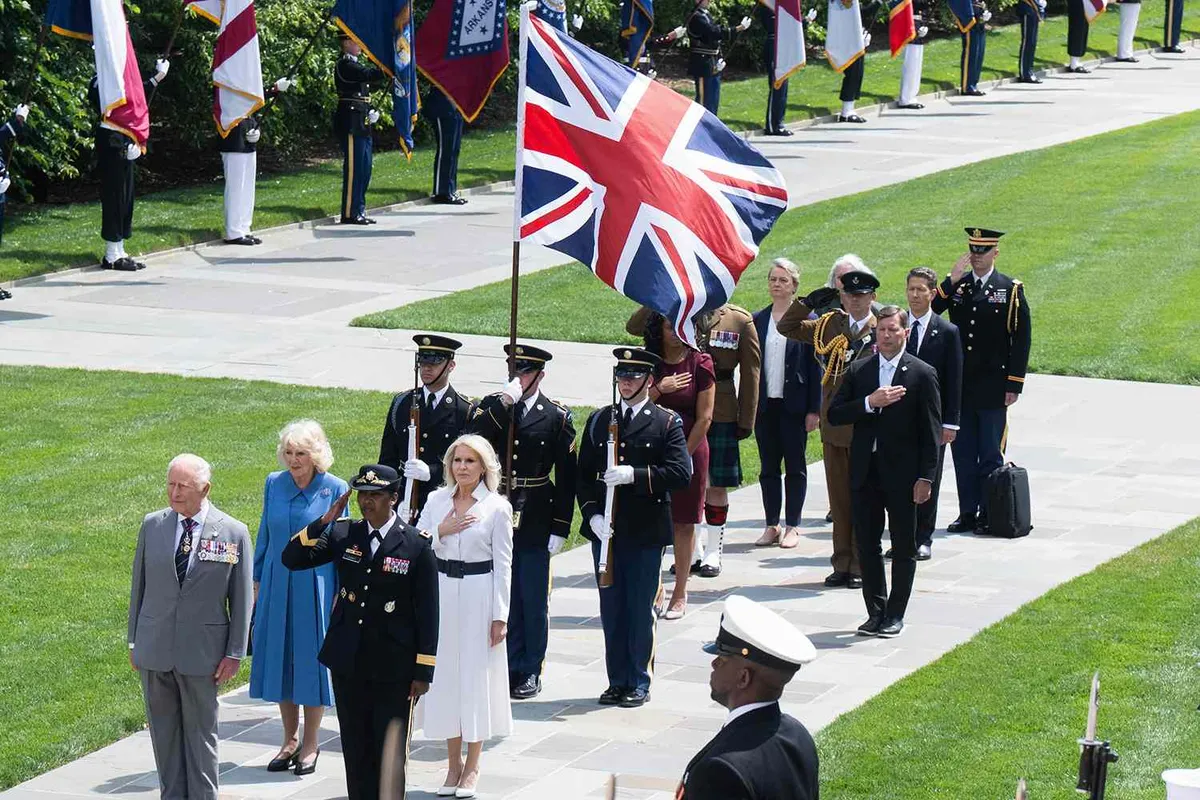
The Union Jack was mistakenly flown upside down during a significant ceremony at Arlington National Cemetery on April 30, 2026, which has been characterized as a notable diplomatic blunder involving King Charles III and Queen Camilla.
During the ceremony, King Charles laid a wreath at the Tomb of the Unknown Soldier, while Queen Camilla placed a posy of flowers. The incident attracted immediate attention due to the incorrect display of the flag, which should be oriented with the wider diagonal white stripe above the red diagonal stripe.
Sources indicate that this mishap has raised concerns about adherence to flag protocol, particularly during high-profile military ceremonies. Britain’s Flag Institute remarked, “It is most improper to fly the flag upside down,” underscoring the seriousness of such errors in diplomatic contexts.
Observers have noted that this is not an isolated incident; earlier in Washington, D.C., Australian flags were erroneously displayed instead of the Union Flag. In that case, officials quickly rectified the error by replacing the Australian flags with the proper representation of British heritage.
This oversight occurred during a visit commemorating America’s 250th anniversary of independence, which further amplifies its significance. The royal couple’s presence was intended to strengthen ties between the United Kingdom and the United States.
Sky News correspondent Mark Stone commented on the situation, describing it as “rather a diplomatic gaff by the Americans here.” Such remarks reflect broader public sentiment regarding national pride and respect for symbols like flags.
The historical context of the Union Jack—uniting the heraldic crosses of England and Wales, Scotland, and Ireland—adds layers to its importance as a symbol of unity. Therefore, any misrepresentation can evoke strong reactions from observers and officials alike.
As discussions about this incident continue, officials have not provided details on how such an error occurred or whether any measures will be implemented to prevent future occurrences. The implications for diplomatic relations remain to be fully assessed.