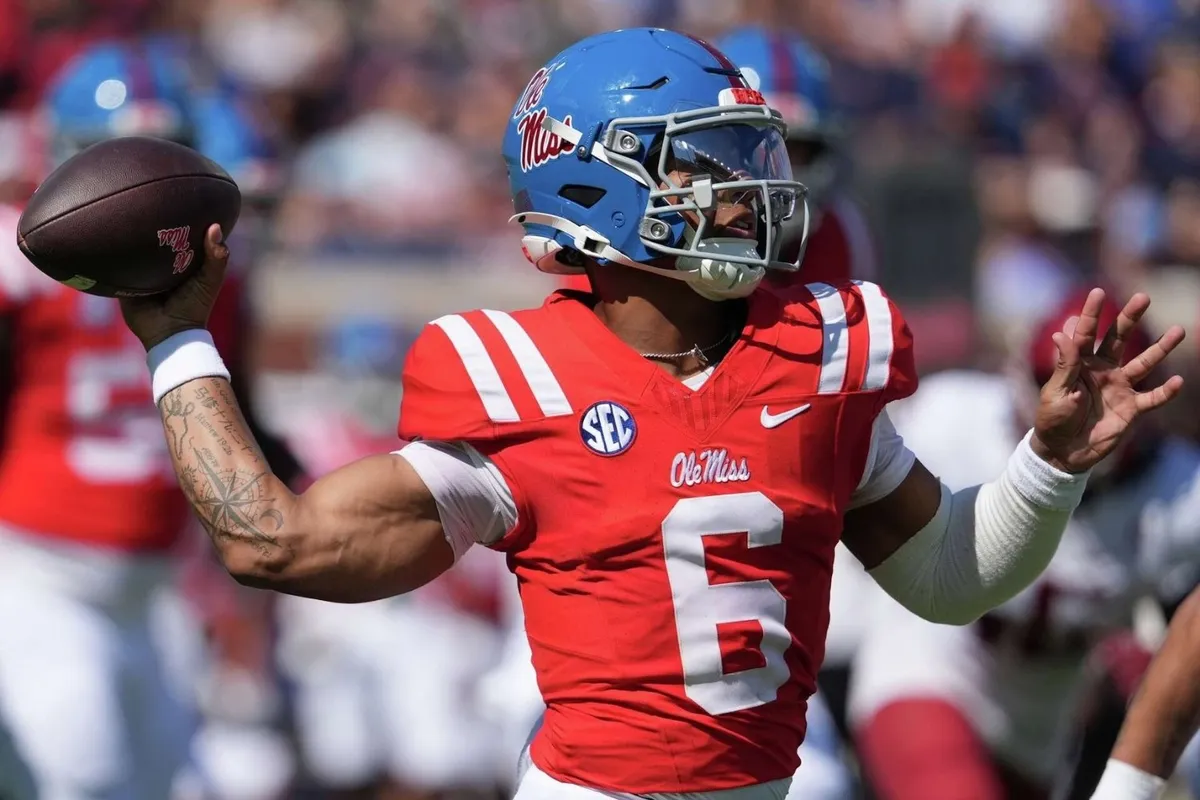
The Mississippi Supreme Court’s recent decision to deny the NCAA’s petition to appeal a preliminary injunction has significant implications for Trinidad Chambliss, allowing him to play for Ole Miss in the 2026 season. This ruling not only marks a pivotal moment in Chambliss’ college football career but also highlights ongoing tensions between athletes’ rights and NCAA regulations.
Chambliss, who transferred to Ole Miss from Ferris State before the 2025 season, has faced numerous challenges, including health issues that hindered his development during his time at Ferris State. He experienced recurrent throat infections, poor sleep quality, daytime fatigue, and exercise-related discomfort following a documented episode of infectious mononucleosis in 2020. These medical concerns led to his application for a retroactive medical redshirt, which the NCAA initially denied on January 9, 2026.
However, Judge Robert Whitwell’s ruling in February 2026 granted Chambliss a sixth year of eligibility, allowing him to compete in the upcoming season. The Mississippi Supreme Court’s decision on March 27, 2026, further solidified this ruling, stating, “We find that the petition should be denied.” This outcome is a significant victory for Chambliss, who has demonstrated remarkable resilience in the face of adversity.
During his time at Ole Miss, Chambliss has made a substantial impact on the field. He led the team to a pair of College Football Playoff wins and finished the last season with impressive statistics: 3,937 yards thrown, 22 touchdown passes, and only three interceptions. His performance earned him the title of SEC newcomer of the year, showcasing his potential as a key player in college football.
In addition to his passing prowess, Chambliss also contributed on the ground, rushing for 527 yards and scoring eight touchdowns last season. His versatility as a quarterback has made him a valuable asset to the Ole Miss Rebels, and fans are eager to see what he will accomplish in the upcoming season.
Despite the positive developments in Chambliss’ case, uncertainties remain. The overall lawsuit ruling regarding his eligibility is not expected to be settled before the season ends, leaving some questions unanswered. Additionally, it is unclear if the NCAA will file a motion for another hearing regarding Chambliss’ case, which could further complicate his situation.
As the 2026 season approaches, the focus will be on Chambliss and his performance on the field. His journey from Ferris State to Ole Miss has been fraught with challenges, but his determination and skill have positioned him as a standout player in college football. Fans and analysts alike will be watching closely to see how he navigates this new chapter in his athletic career.