The wider picture
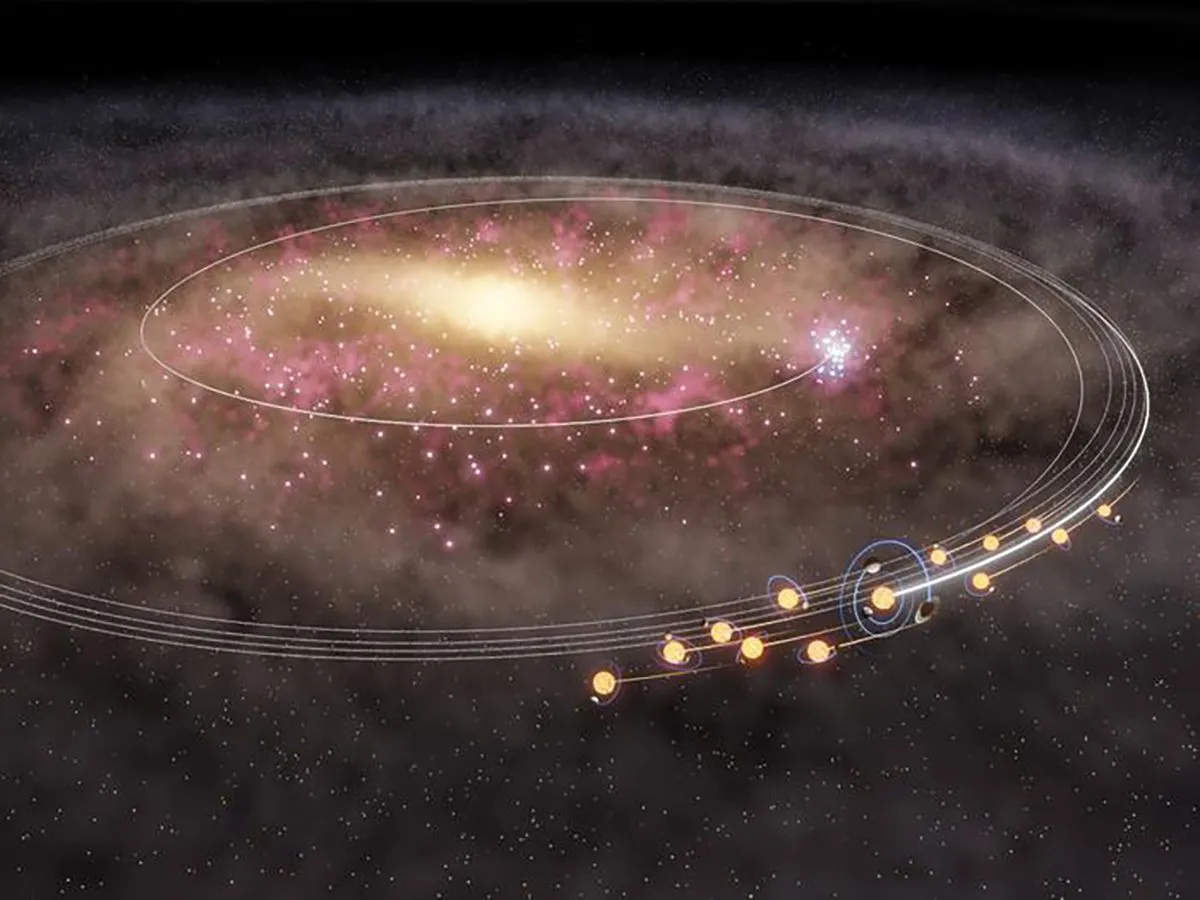
The cosmos is thought to be 13.8 billion years old, and within this vast expanse, our Sun has a remarkable history. It was born approximately 4.6 billion years ago, initially located about 10,000 lightyears closer to the center of the Milky Way galaxy than it is today. This positioning is crucial to understanding the Sun’s journey and its implications for life on Earth.
Recent research conducted by a team of scientists from Tokyo, Japan, has provided new insights into the Sun’s origins and its migration through the galaxy. Utilizing data from the European Space Agency’s Gaia satellite, which has measured the positions, distances, and motions of around two billion stars, the researchers were able to create a detailed 3D map of the Milky Way.
The study resulted in a catalogue of 6,594 stellar twins, allowing the scientists to gain a clearer perspective on the ages of these stars. Among their findings, they identified a broad peak for stars that are approximately 4 to 6 billion years old, including our Sun, which now occupies a position that enhances the likelihood of life developing.
One of the most significant implications of this research is the understanding that the migration of our Sun from the center of the galaxy brought it into a region where conditions were more favorable for life. The study suggests that without this mass migration of Sun-like stars, life as we know it may never have emerged on Earth.
As the Sun traveled through the galaxy, it encountered various cosmic phenomena that shaped its environment. The movement of stars in the galaxy is not static; it is dynamic, with nearby stars moving across the sky over the course of approximately 400 thousand years. This constant motion contributes to the changing conditions in which stars, including our Sun, exist.
Initial reactions from the scientific community highlight the significance of these findings. Researchers emphasize that understanding the Sun’s migration provides valuable context for studying the formation of planetary systems and the emergence of life. Observers note that this research opens new avenues for exploring how stellar environments influence the potential for life in the universe.
Looking ahead, scientists anticipate that further studies will build on these findings, delving deeper into the implications of stellar migration and its role in the development of life. As more data becomes available, the cosmic narrative of our Sun and its journey through the galaxy will continue to unfold, revealing the intricate connections between stars and the emergence of life on planets like Earth.