“NATO is a paper tiger,” remarked former President Donald Trump, a statement that resonates with ongoing debates about the organization’s effectiveness and future. This quote underscores the skepticism surrounding NATO’s role, especially in light of the United States’ critical support.
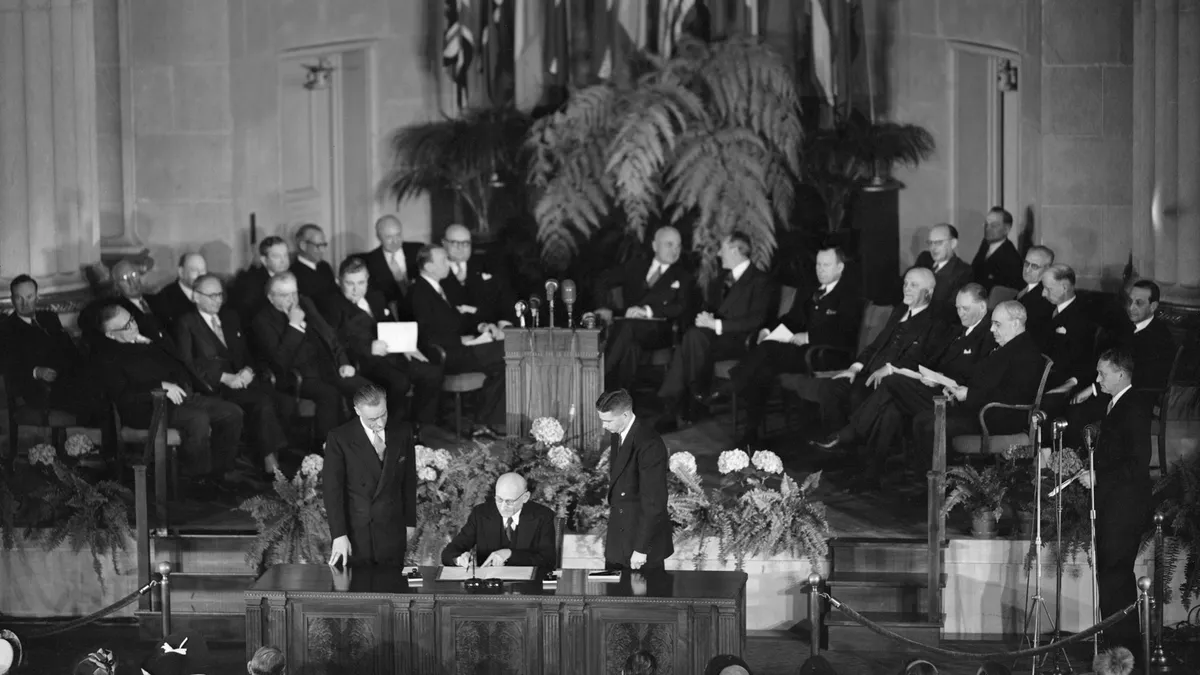
NATO, or the North Atlantic Treaty Organization, stands as a cornerstone of collective defense among its member states. Established in 1949, the alliance has relied heavily on the military support and nuclear assurance provided by the United States. This support is encapsulated in Article 5 of the NATO treaty, which asserts that an attack on one member is an attack on all.
Recent developments have sparked renewed discussions about NATO’s future, particularly in the context of U.S. involvement. The U.S. Constitution mandates that treaties require two-thirds Senate consent for ratification, but it remains silent on the process for withdrawal. This ambiguity has led to concerns about potential U.S. disengagement from NATO.
Section 1250A of the 2024 National Defense Authorization Act has introduced a safeguard, stating that the president may not withdraw from NATO without congressional approval. This legislative move reflects a growing recognition of NATO’s importance to both European and global security.
Withdrawal from NATO would not only be a complex legal maneuver but could also have catastrophic consequences for international stability. NATO Secretary General Mark Rutte emphasized that “the US umbrella remains the ultimate guarantor of European security,” highlighting the reliance of European nations on American military backing.
In response to evolving threats, NATO’s European members and Canada have significantly increased their defense spending, with a reported 20% rise expected by 2025. This increase is part of a broader strategy to enhance collective defense capabilities.
Countries like Poland, Lithuania, and Latvia have surpassed the 3.5% GDP benchmark for core defense spending, demonstrating a commitment to strengthening their military readiness. Such investments are crucial as NATO contemplates its operational framework in a scenario without U.S. support.
A NATO without the backing of the United States would necessitate the formation of a local operational core, potentially centered around Britain, France, Germany, Poland, and the Baltic-Nordic states. This shift would mark a significant change in the alliance’s structure and strategy.
As NATO navigates these challenges, the dialogue surrounding its meaning and relevance continues to evolve. The next steps for the organization will likely involve further discussions on defense commitments and the role of member states in ensuring collective security.