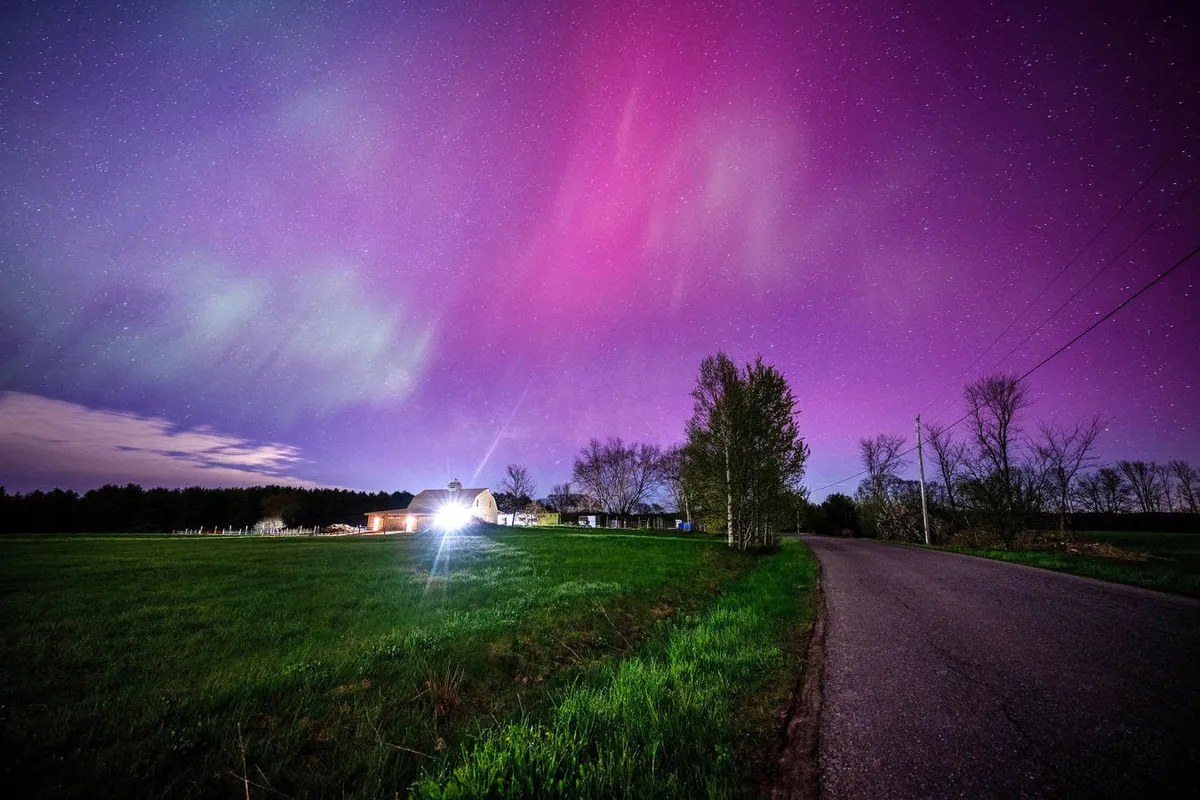
Will the northern lights be visible across the United States on March 31? Yes, thanks to a coronal mass ejection (CME) from a solar flare observed on March 30, forecasters predict that the aurora borealis could be seen from several states.
According to the National Oceanic and Atmospheric Administration (NOAA), a Kp index of five out of nine is expected, which suggests that the aurora may appear brighter and more visible further south than usual. This is particularly significant as NOAA has issued a strong geomagnetic storm watch for March 31, indicating that storm conditions could reach a G3 level on their scale.
The auroras are anticipated to be visible from Alaska down to Wyoming, covering a vast area of the northern United States. Specifically, the lights could be seen from most of Washington, the Idaho Panhandle, Montana, northeastern Wyoming, North Dakota, and South Dakota. Additionally, the upper Midwest, including Minnesota, northern Iowa, Wisconsin, and northern Michigan, may also experience this natural phenomenon.
On the East Coast, viewers in the northern parts of New York, Vermont, New Hampshire, and Maine could catch a glimpse of the auroras. Experts at NOAA note that the northern lights can be visible up to 600 miles south of where they typically appear, enhancing the chances for many to witness this spectacular event.
The best time to observe the northern lights is generally between 10 p.m. and 2 a.m., and conditions are expected to be optimal for viewing. However, details remain unconfirmed, as the exact visibility will depend on local weather conditions, such as cloud cover and rain.
Furthermore, a G2 solar storm is forecasted for March 31, with a possibility of seeing the lights again on April 1, albeit at a minor strength. If conditions strengthen when the CME hits, the auroras could extend farther south than predicted.
As excitement builds, experts advise viewers to dress warmly and be patient, as auroras can be unpredictable, often erupting suddenly before fading just as quickly. The northern lights could twinkle over Vermont and 13 other states tonight, creating a breathtaking spectacle for those fortunate enough to witness it.
In summary, the upcoming aurora forecast presents a unique opportunity for many across the United States to experience the beauty of the northern lights, a phenomenon that continues to captivate and inspire awe.